Welcome to Hotfun Rides website!

Carousel Ride Horse Material wood vs FRP?
When clients compare Carousel Ride Horse Material wood vs FRP, the discussion usually starts with appearance.
Wood looks traditional
FRP looks modern
But that distinction becomes less important after the ride has been operating for one or two seasons.
Because the real difference does not show on day one
It shows after exposure to weather, repeated loading, and maintenance cycles
The First Impression Is Often Misleading
Hand carved wooden horses immediately stand out.
They have:
- Natural grain variation
- Sharper carved details
- A traditional visual style that many classic parks prefer
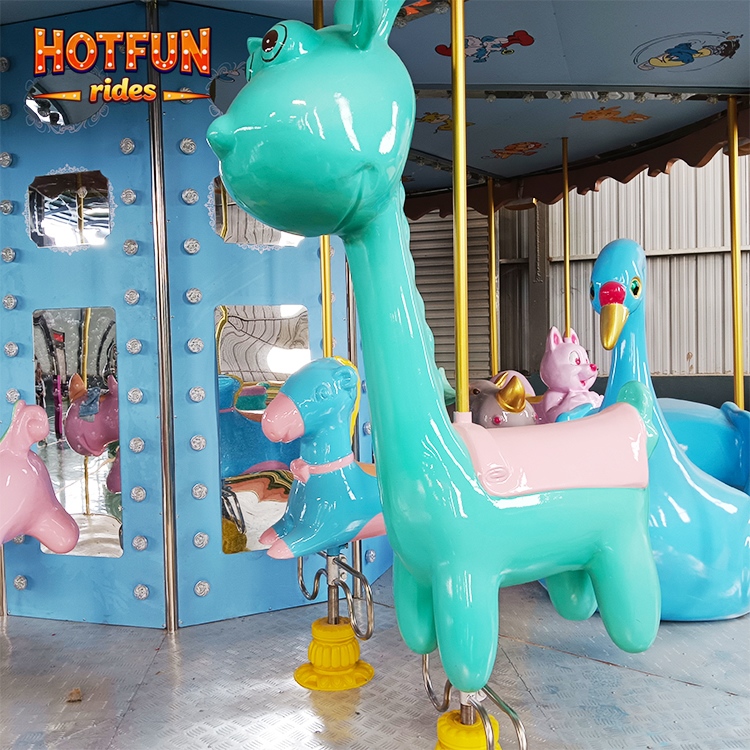
FRP horses, on the other hand, are molded.
They are:
- Consistent in shape
- Smooth in surface finish
- Easier to reproduce in large quantities
At installation stage, both can look equally good if finished properly.
The difference begins later.
What Happens After One Year of Operation
This is where material behavior becomes visible.
Wooden carousel horses
Even when sealed and painted correctly, wood remains a natural material.
In outdoor environments, it reacts to:
- Humidity changes
- Temperature cycles
- UV exposure
Typical observations after one year:
- Minor expansion or contraction
- Possible paint micro cracking at joints
- Need for surface inspection and touch up
This does not mean wood fails
It means it requires attention
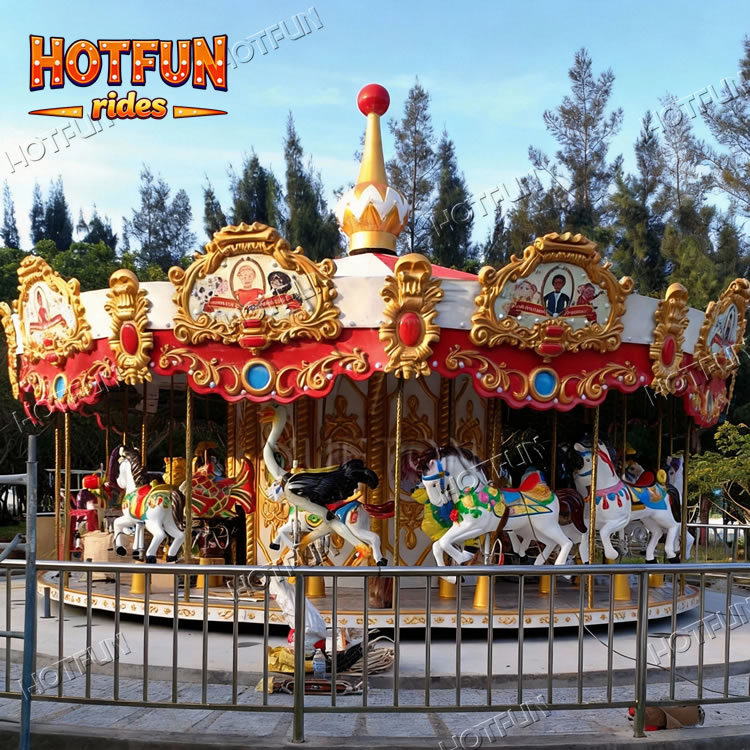
FRP carousel horses
FRP, fiberglass reinforced plastic, behaves differently.
It is dimensionally stable.
Under the same conditions:
- No expansion or contraction like wood
- Surface remains consistent if coating is intact
- Less sensitivity to humidity
After one year, most FRP horses show minimal structural change
Only normal surface wear depending on usage
Weight and Structural Load Considerations
This part is often overlooked but important for long term operation.
Typical weight ranges:
- Wooden carousel horse: around 40 to 70 kg depending on size and carving density
- FRP carousel horse: around 20 to 40 kg for similar dimensions
Lower weight means:
- Reduced load on rotating structure
- Less stress on poles and connection points
- Smoother long term mechanical performance
This is one reason why modern medium and large carousels often use FRP
Surface Durability and Maintenance
Surface performance depends not only on material but also on coating.
However, material still plays a role.
Wood
- Requires sealing before painting
- More sensitive to water penetration if coating is damaged
- Maintenance cycle typically every 2 to 4 years for repainting or refinishing in outdoor use
FRP
- Non porous base material
- Coating sits on a stable surface
- Maintenance cycle can extend to 3 to 5 years depending on environment and usage
These are realistic maintenance ranges based on outdoor decorative structures, not ideal conditions
Repair Behavior Is Different
This is where practical operation decisions are made.
Wooden horses
- Can be repaired locally by sanding and repainting
- Carved details can be restored by skilled workers
- Requires craftsmanship, not just replacement
FRP horses
- Minor damage can be repaired using resin and surface finishing
- Severe damage often leads to part replacement rather than detailed restoration
So the choice is not just about durability
It is about how you plan to maintain the ride over time
Cost Perspective Without Exaggeration
In real market conditions:
- Hand carved wooden horses are usually more expensive due to labor
- FRP horses are more cost efficient in batch production
The price difference varies by design complexity, but wood is rarely the lower cost option when carving quality is high
Where Each Material Actually Fits
From real project experience:
Wooden carousel horses are more suitable for:
- Heritage style parks
- Indoor installations with controlled environment
- Projects where visual authenticity is a priority
FRP carousel horses are more suitable for:
- Outdoor parks
- High traffic commercial operations
- Projects focused on durability and lower maintenance frequency
How HOTFUN Chooses Between Wood and FRP
At HOTFUN, the decision is not made based on preference alone.
It is based on three practical factors:
- Installation environment
- Expected daily operation time
- Maintenance capability of the operator
For outdoor commercial projects, FRP is usually recommended due to stability and lower maintenance pressure.
For themed or classic style projects, wood is still used where visual detail is the priority and maintenance is planned accordingly.
A More Realistic Way to Compare
Instead of asking which material is better, a more useful question is:
What will this ride look like after three years
Because that is when the difference becomes visible
Not in the showroom
But in real operation
Final Thought
Carousel Ride Horse Material wood vs FRP is not just a material comparison
It is a choice between tradition and practicality
Wood offers character but requires care
FRP offers consistency with less intervention
And the right decision depends less on how the ride looks on day one
and more on how it will perform over time