Welcome to Hotfun Rides website!





Carousel Ride Maintenance Cost: What to Expect Yearly
Investing in a carousel is one of the safest bets for any amusement park, Family Entertainment Center (FEC), or shopping mall. It’s a timeless attraction with a high hourly capacity and excellent ROI. However, before signing the purchase contract, every smart investor asks the same operational question: What is the actual carousel ride maintenance cost per year?
Unlike extreme thrill rides, carousels are relatively low-maintenance. Still, keeping a 16-seat to 36-seat machine running smoothly, safely, and beautifully 365 days a year requires a dedicated budget.
Based on industry standards and operational data from commercial parks, here is a realistic breakdown of what you should expect to spend annually to maintain your carousel.
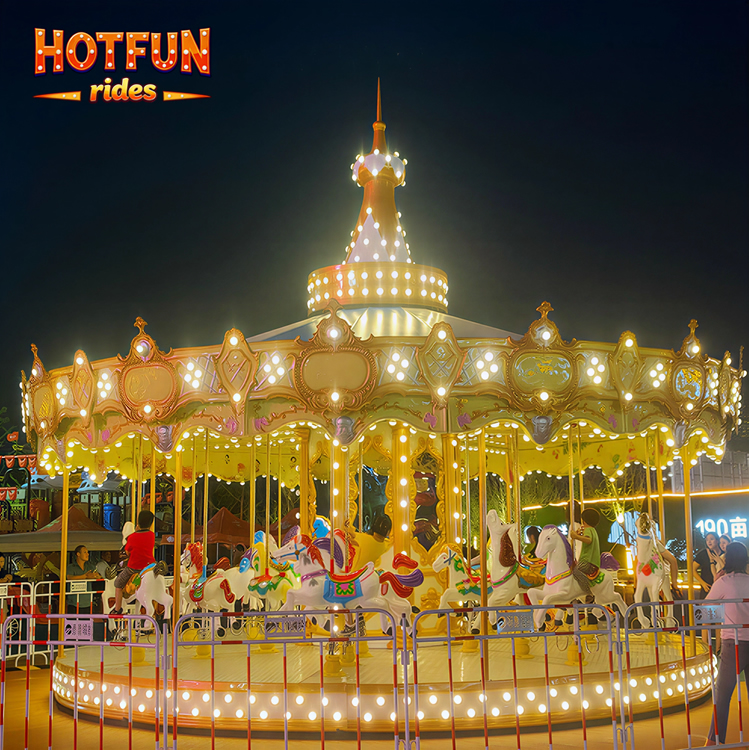
The Short Answer: Average Annual Maintenance Budget
For a standard commercial carousel (16 to 36 seats) operating 8 to 10 hours a day, the expected carousel ride maintenance cost typically ranges from $1,500 to $4,500 per year.
This figure heavily depends on three factors:
- Operating Environment: Indoor carousels (malls) cost significantly less to maintain than outdoor carousels exposed to rain, UV rays, and salty coastal air.
- Ride Size: A 56-seat double-decker carousel will naturally consume more electricity, grease, and labor than a compact 16-seat model.
- Age of the Equipment: Brand-new rides under warranty cost mostly labor and basic consumables, while rides over 5 years old may require parts replacement.
Breakdown of Yearly Maintenance Expenses
To give you a clear picture, let’s break down the costs into real-world operational scenarios.
1. Mechanical Wear and Tear (Lubrication & Drive System)
The heart of your carousel is the slew bearing (the massive ring gear under the platform) and the drive motor.
- Consumables: High-quality lithium grease for the slew bearing, gears, and the up-and-down crankshafts of the horses.
- Replacement Parts: V-belts or transmission wheels that transfer power from the motor to the rotation system will wear out over time. If your carousel uses an older DC motor, you will also need to replace carbon brushes.
- Estimated Annual Cost: $300 – $600. (Modern AC motors with Variable Frequency Drives [VFD] require zero carbon brush replacements, saving you money).
2. Electrical and Lighting (LEDs & Slip Rings)
A carousel without its dazzling lights loses its magic. A standard 24-seat carousel can have anywhere from 800 to 1,500 LED bulbs.
- Lighting: Even with a 50,000-hour lifespan, voltage fluctuations or weather can cause 2% to 5% of bulbs to fail annually. Replacing 50 bulbs at $2-$3 each adds up.
- Slip Ring: The conductive slip ring (which transfers electricity from the stationary center pole to the rotating roof) needs annual cleaning and occasional carbon contact replacements to prevent sparking and power drops.
- Estimated Annual Cost: $200 – $500.
3. Cosmetic Upkeep (Fiberglass and Paint)
Kids kick, scratch, and spill drinks. The fiberglass (FRP) horses and carriages take a daily beating.
- Cleaning Supplies: Industrial-grade, non-abrasive cleaners to keep the FRP shining without stripping the clear coat.
- Touch-ups: Professional automotive-grade touch-up paint and clear coats to fix chipped hooves or scratched poles before they look “cheap.”
- Estimated Annual Cost: $200 – $400. (Outdoor carousels will hit the higher end of this budget due to UV fading).
4. Safety Inspections and Certifications
This is the hidden cost many new operators forget. According to ASTM F770 standards (or local equivalent safety regulations), commercial amusement rides must undergo periodic safety inspections.
- Third-Party Audits: Paying a certified state inspector or an independent safety engineer to perform annual Non-Destructive Testing (NDT) on critical load-bearing shafts.
- Estimated Annual Cost: $500 – $1,500+, depending on your country and state laws.
The Hidden Variable: Labor Costs
The materials and parts for carousel maintenance are cheap; the labor is not.
A standard preventive maintenance schedule requires a technician to spend about 15 to 30 minutes every morning before the park opens to:
- Check safety belts and lap bars.
- Listen for abnormal friction noises in the motor.
- Wipe down the poles and sweep the platform.
- Test the emergency stop (E-stop) buttons.
At an average of 3 hours per week, that is roughly 150 labor hours per year. While this is an internal payroll cost rather than an out-of-pocket parts expense, it must be factored into your park’s operational ROI calculations.
Pro Tips to Lower Your Carousel Ride Maintenance Cost
If you want to keep your annual expenses closer to the $1,500 mark, focus on proactive purchasing and preventive care:
- Invest in Auto-Lubrication: When buying a new carousel, ask the manufacturer for an automatic lubrication system. It drips the exact amount of oil onto the bearings daily, eliminating human error and preventing catastrophic $5,000 bearing failures.
- Choose IP65 Waterproof LEDs: If operating outdoors, never accept standard indoor bulbs. IP65-rated LEDs are sealed against rain and condensation, drastically cutting your bulb replacement rate.
- Buy Custom Covers: For outdoor FECs, investing $300 in a heavy-duty custom tarp to cover the ride during off-seasons or heavy storms will save you thousands in paint restoration and electrical repairs over a 5-year period.
Maintaining a carousel isn’t about fixing it when it breaks; it’s about spending a few dollars a day so it never stops spinning. By budgeting realistically for your annual maintenance, you ensure that your carousel remains the reliable, profitable centerpiece of your business.