¡Bienvenido al sitio web de Hotfun Rides!
Tamaño de la Atracción Carrusel: Guía de Espacio Real por Modelo
Introduction
When a project reaches the equipment confirmation stage, one question always comes up, regardless of country:
Is this pirate ship actually compliant?
That is where Pirate Ship Ride Safety becomes more than a technical term. It becomes a deciding factor for import approval, installation inspection, and long term operation.
Many buyers assume that safety simply means the ride “looks strong” or “has certificates.” In reality, international inspectors do not evaluate equipment based on appearance. They evaluate whether the entire system can operate safely under repeated dynamic stress.
From HOTFUN project experience across different markets, most delays are not caused by manufacturing, but by misunderstanding what international safety standards actually require.
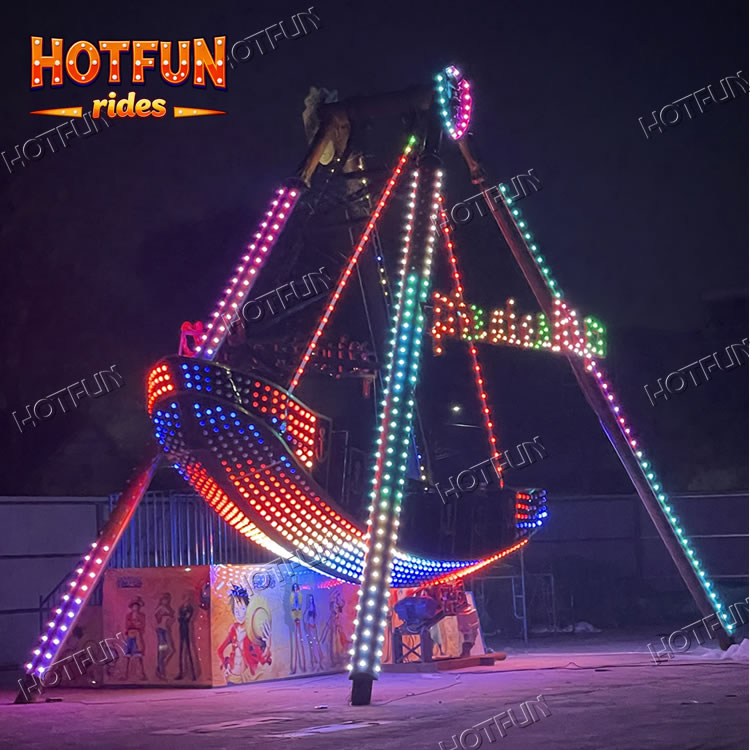
What Pirate Ship Ride Safety Really Means On Site
In real projects, Pirate Ship Ride Safety is not judged by a single test or document.
It is judged by whether the ride can:
- Withstand continuous swing cycles without structural fatigue issues
- Maintain stable restraint performance across all seats
- Respond instantly in emergency conditions
- Pass inspection under actual operating conditions, not just factory testing
In other words, safety is not a feature. It is a system that must remain stable over time.
International Standards Behind Pirate Ship Ride Safety
Different countries may use different regulatory systems, but most imported equipment is evaluated based on a few core frameworks.
EN 13814 Standard (Europe and Export Markets)
For many international projects, EN 13814 is the reference point.
It focuses heavily on:
- Structural load calculations under repeated motion
- Fatigue life of key components
- Material selection and welding quality
- Inspection and maintenance procedures
For a pirate ship, this matters because the ride is not static. The structure is constantly moving, which means fatigue is more important than initial strength.
ASTM F24 Standard (United States and Related Markets)
ASTM standards are more operation oriented.
They look at:
- How the ride is used daily
- Whether emergency systems respond correctly
- Maintenance documentation and procedures
- Operator responsibilities
In practice, a ride may pass design checks but still fail if operational logic is not compliant.
Combined Compliance Reality
In export projects, especially in mixed regulatory regions, it is common that equipment must satisfy both:
- Design level safety (EN logic)
- Operation level safety (ASTM logic)
This is where many low experience suppliers struggle.
Structural Safety Where Most Risks Actually Begin
From a technical perspective, the highest risk in Pirate Ship Ride Safety is not the visible structure. It is the long term stress concentration at moving (pivot points).
In real inspections, engineers pay attention to:
- Whether stress is evenly distributed along the main support
- Whether welding areas show early fatigue signs
- Whether the swing remains symmetrical over time
A structure can pass factory inspection but still develop issues after months of operation if fatigue was underestimated.
At HOTFUN, structural design is calculated based on repeated load cycles, not just static capacity. This is a key difference between equipment that passes inspection once and equipment that runs reliably for years.
Restraint System The Most Sensitive Part of Pirate Ship Ride Safety
If there is one area inspectors focus on the most, it is the restraint system.
A compliant system is not just about locking. It must ensure:
- Equal locking force across all seats
- No delayed or partial engagement
- Redundant safety mechanisms functioning automatically
In actual operation, problems rarely come from complete failure. They come from inconsistency.
For example:
- One seat locks slightly differently
- Pressure varies between positions
- Release timing is not uniform
These are the issues that fail inspections.
Control System and Emergency Response
Modern pirate ships rely heavily on control systems to maintain safe operation.
For Pirate Ship Ride Safety, inspectors typically check:
- Emergency stop response time
- Braking stability under full load
- Sensor accuracy for position control
- System behavior during unexpected interruptions
One detail often overlooked by buyers:
A system that works in normal conditions is not enough.
It must also behave predictably when something goes wrong.
Installation Reality Safety Does Not End at the Factory
One of the most misunderstood parts of Pirate Ship Ride Safety is installation.
Even a fully compliant ride can fail inspection if:
- Foundation alignment is slightly off
- Anchor bolts are not installed correctly
- Swing clearance is insufficient
In several real projects, equipment passed factory tests but required rework on site due to installation deviation, not manufacturing issues.
That is why experienced suppliers provide installation guidance as part of the safety system.
Daily Operation and Maintenance The Hidden Part of Safety
International standards do not stop at delivery.
They require:
- Daily inspection routines
- Regular maintenance schedules
- Documented operation procedures
From actual park operations, most safety risks appear not in the first months, but after:
- Maintenance is delayed
- Small issues are ignored
- Inspection routines become inconsistent
This is where long term reliability is decided.
How HOTFUN Ensures Pirate Ship Ride Safety in Real Projects
From a manufacturing perspective, safety is not added later. It is built into the process.
In HOTFUN projects, this includes:
- Structural design based on dynamic load calculations
- Clear inspection access points for daily checks
- Stable control system configuration
- Practical installation support, not just drawings
The goal is not just to meet standards, but to ensure the ride remains stable under real operating conditions.
Conclusion
Understanding Pirate Ship Ride Safety requires looking beyond certificates and specifications.
It is about whether the ride can:
- Pass inspection
- Operate consistently
- Maintain safety over time
International standards define the framework, but real safety is determined by how the ride performs after installation, under daily use.
Final Thought
When evaluating a supplier, it is worth asking a more practical question:
Are they providing a product that can pass inspection once,
or a system that will remain compliant every day after it starts operating?