Welcome to Hotfun Rides website!
Flying Tower Ride Safety inspection 2026?
Most operators don’t think about Flying Tower Ride Safety Inspection something forces them to.
A certification deadline.
A minor abnormal noise.
Or simply a regulatory requirement.
But once you run a ride daily, the question changes:
It’s no longer “Do we need inspection?”
It becomes
“When do we inspect without killing revenue?”
Because inspection doesn’t just cost money—it interrupts operation.
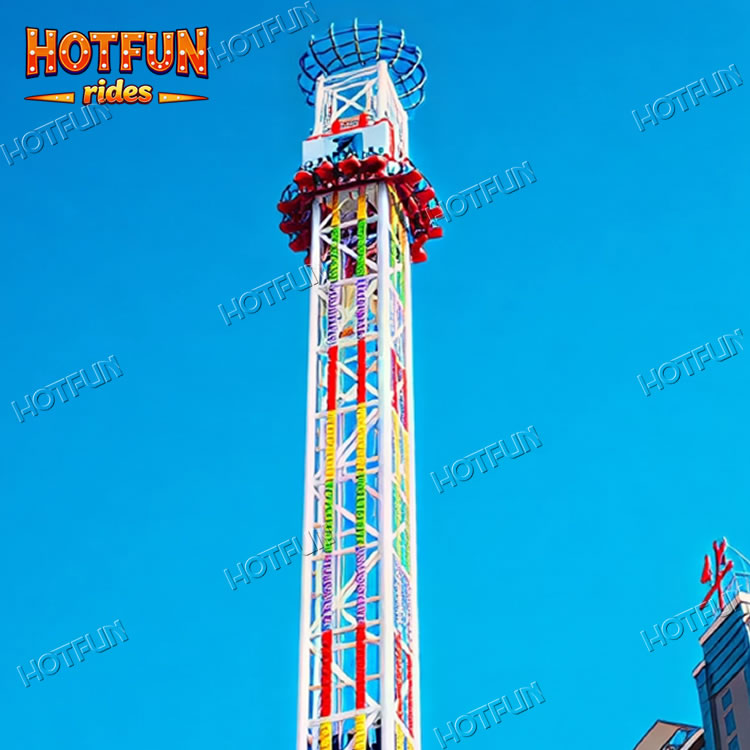
A Real Operating Day (And Where Inspection Actually Fits)
Let’s take a typical operating schedule for a mid-size flying tower ride:
- Opening: 10:00
- Peak flow: 13:00–18:00
- Closing: 21:00
Now here’s the problem:
A full Flying Tower Ride Safety Inspection —even a routine one—can take:
- 2–4 hours for standard checks
- Up to 1 full day if parts replacement or recalibration is required
So where do you place it?
Most new operators choose the obvious option:
👉 “Do it during the day when staff is available”
That’s usually the wrong decision.
The Hidden Cost of Daytime Inspection
Stopping the ride during operating hours creates three immediate effects:
- Lost revenue per hour
- Customer dissatisfaction (closed attraction)
- Disrupted traffic flow in the park
From real operations:
- A medium flying tower can serve 120–200 riders/hour
- Even at a modest ticket value, downtime quickly outweighs inspection cost
Which means:
👉 The real cost of Flying Tower Ride Safety Inspection is not the inspection itself
👉 It’s when you choose to do it
What Actually Gets Checked (Without Overcomplicating It)
Most inspections focus on three core systems:
Structural Integrity
- Central tower vertical alignment
- Swing arm connections
- Weld stress points
These rarely fail suddenly—but small issues accumulate over time.
Rotation & Suspension System
This is where operators should pay attention.
Typical wear points:
- Bearings
- Rotating joints
- Suspension chains or connectors
From industry data:
👉 Bearing replacement (if needed): $200–$600 per unit
👉 Lubrication & adjustment: low cost, but high importance
Electrical & Safety Control
- Emergency stop response time
- Speed control limits
- Sensor calibration
Most of this is not expensive—but critical for compliance.
What Changes in (Compared to Older Practice)
In recent years, inspection is shifting from “periodic shutdown” to planned integration into operation.
Experienced operators no longer treat Flying Tower Ride Safety Inspection as a separate task.
They treat it as part of scheduling.
How Operators Actually Reduce Downtime
From real project observations, three strategies consistently work:
1. Pre-Opening Inspection Window
- Conduct checks between 6:00–9:30 AM
- Ride is ready before visitors arrive
This is the most efficient option when staffing allows.
2. Split Inspection Method
Instead of one long shutdown:
- Day 1: structural + visual checks
- Day 2: electrical + calibration
Each session takes 1–2 hours, reducing full downtime.
3. Low-Traffic Time Slot (Not Just “Anytime”)
Not all non-peak hours are equal.
Best window:
👉 Early afternoon transition (around 12:00–13:00)
Before peak flow builds up.
Worst window:
👉 Late afternoon (peak build-up phase)
Where Profitability Is Actually Decided
Here’s the part most operators don’t calculate.
Let’s assume:
- Inspection cost: $800–$1,500 annually (typical range)
- Lost revenue from 3 hours downtime during peak: often higher than that
So the decision is not:
👉 “How much does inspection cost?”
It’s:
👉 “How much does bad scheduling cost?”
What Experienced Operators Do Differently
After one season, behavior usually changes.
They stop asking:
- “How often should we inspect?”
And start asking:
- “How do we inspect without stopping the ride when it matters?”
That shift alone improves annual revenue more than reducing inspection cost.
How HOTFUN Supports Smarter Inspection Planning
At HOTFUN, safety inspection is not treated as an afterthought.
Accessible Component Design
Critical parts are easier to reach, reducing inspection time.
Stable Mechanical Systems
Lower wear rate means fewer unexpected shutdowns.
Pre-Configured Safety Systems
Less time spent on calibration during routine checks.
Operator Guidance
Helping clients plan inspection timing alongside operating schedules—not separately.
Final Thought: Inspection Is Not the Problem—Timing Is
Looking at real operations, one thing stands out:
Every operator performs Flying Tower Ride Safety Inspection .
But not every operator manages it well.
The difference is simple:
- One treats inspection as a task
- The other treats it as part of the business model
And in a ride that runs hundreds of cycles per day,
that difference shows up very quickly—in revenue.