Welcome to Hotfun Rides website!
Indoor Trackless Train Ride: Engineering Reality, Safety Control and ROI for Indoor Venues
Why the Indoor Trackless Train Ride Is Becoming Common in Shopping Centers
Over the past decade, the Indoor Trackless Train Ride has gradually become one of the most practical mobile attractions inside shopping malls, exhibition centers and family entertainment venues. Unlike traditional amusement trains that require steel tracks, an Indoor Trackless Train Ride operates directly on existing floors such as polished tile, marble or epoxy-coated surfaces.
For many operators, the appeal is simple: no rail construction, flexible routes and relatively low installation disruption. In most cases, the train can be delivered, assembled on site, and start operation within a single day.
However, running an Indoor Trackless Train Ride inside a crowded indoor environment introduces a different set of technical challenges compared with outdoor amusement parks. Indoor venues usually involve dense pedestrian traffic, tighter turning corridors and highly polished flooring materials that reduce tire friction.
Because of these factors, manufacturers must design the Indoor Trackless Train Ride with careful attention to steering geometry, braking redundancy, floor pressure control and battery safety.
For park investors and mall operators, understanding these engineering details is essential before making a purchasing decision.
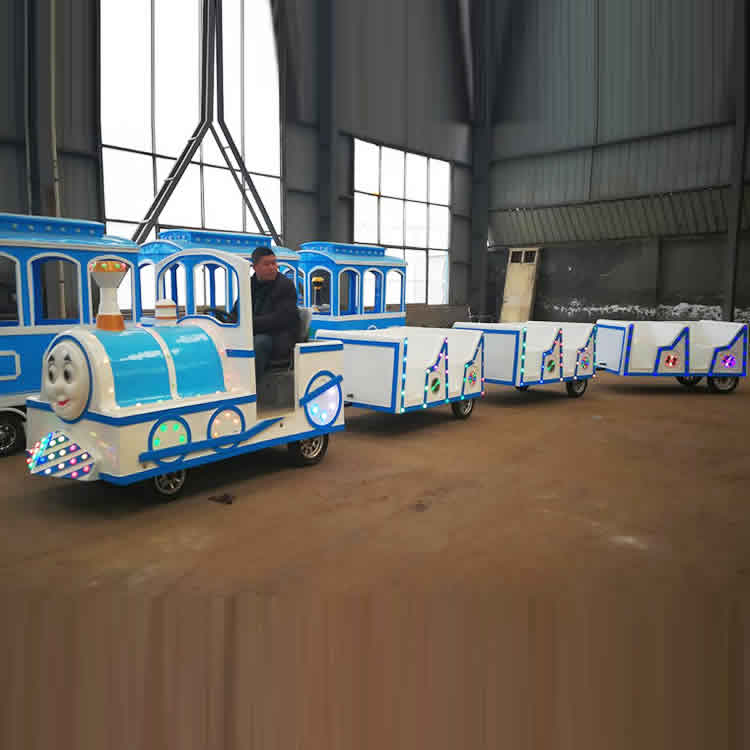
Floor Load Engineering for Indoor Trackless Train Ride Systems
One of the first technical questions raised by property managers is whether an Indoor Trackless Train Ride could damage expensive interior flooring.
In practice, the floor pressure created by a train is lower than many people expect.
A typical commercial Indoor Trackless Train Ride designed for indoor venues usually includes:
- 1 electric locomotive
- 3 passenger carriages
- 16 to 24 passenger capacity
When fully loaded with passengers, the total operating weight generally ranges between 1.8 and 2.5 tons.
Because this weight is distributed across multiple wheels, the actual pressure transmitted to the floor normally remains within 40–60 PSI. For comparison, cleaning machines used in large malls often produce similar or higher point loads.
For this reason, modern shopping mall flooring systems can safely support an Indoor Trackless Train Ride without structural concerns.
Why Solid Rubber Tires Are Preferred Indoors
Most indoor train manufacturers avoid pneumatic tires and instead use industrial solid rubber wheels.
From a maintenance perspective, solid tires solve several operational issues:
- no punctures caused by debris
- no pressure monitoring required
- consistent contact surface for braking
Another important detail is the tire compound itself. High-quality rubber formulations are specifically designed to minimize black marks on polished tile or marble flooring.
This is particularly important for indoor venues where floor appearance directly affects the customer experience.
Steering Geometry in Narrow Indoor Routes
A standard Indoor Trackless Train Ride uses a steering mechanism commonly referred to as true-track steering.
Instead of allowing each carriage to rotate freely, the steering linkage connects the locomotive and the carriages using mechanical rods and pivot joints. When the locomotive turns, every carriage follows the same path.
In tight indoor corridors this design prevents the rear cars from swinging outward, which significantly reduces the risk of contact with walls, decorative installations or retail kiosks.
Safety Control Systems in an Indoor Trackless Train Ride
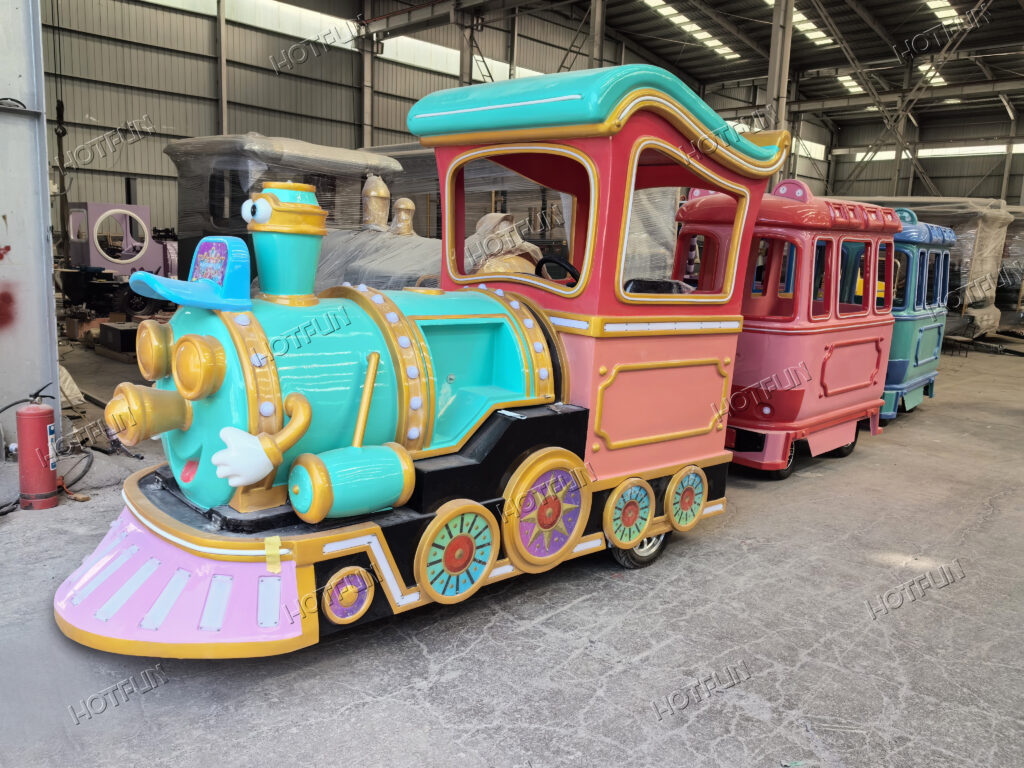
Operating passenger attractions inside crowded indoor spaces requires multiple safety redundancies. Professional Indoor Trackless Train Ride manufacturers typically combine mechanical and electronic safety systems.
Multi-Axle Braking Systems
Instead of relying only on the locomotive brakes, many commercial Indoor Trackless Train Ride models integrate synchronized braking across several axles.
When the driver presses the brake pedal, hydraulic force is distributed to the train wheels in a balanced way. This improves stability and prevents sudden load shifts during emergency stops.
Typical indoor operating speeds are intentionally limited to 3–5 km/h, roughly the speed of a walking pedestrian.
Electronic Speed Limitation
In addition to physical braking systems, the traction controller of an Indoor Trackless Train Ride usually includes electronic speed limitation.
Even if the operator presses the accelerator fully, the control system prevents the vehicle from exceeding a predefined maximum speed.
This design helps reduce human error during operation.
Emergency Stop System
Every Indoor Trackless Train Ride locomotive includes a large emergency stop switch positioned near the driver.
Activating the emergency stop immediately cuts electrical power to the traction motor and engages braking resistance. The train then decelerates safely within a short distance.
In indoor environments with unpredictable pedestrian movement, this feature is critical.
Battery Systems Used in an Indoor Trackless Train Ride
Because the train operates indoors, the power system must be clean, stable and safe.
Two battery technologies are commonly used in modern Indoor Trackless Train Ride vehicles.
Sealed Lead-Acid Batteries
Maintenance-free AGM or VRLA batteries are still widely used in entry-level train models.
Their advantages include:
- lower upfront cost
- simple charging systems
- proven reliability in electric vehicles
Typical cycle life ranges between 400 and 600 charge cycles, depending on how deeply the batteries are discharged during operation.
Lithium Iron Phosphate Batteries
Higher-end Indoor Trackless Train Ride equipment increasingly uses lithium iron phosphate batteries.
These batteries provide:
- longer service life (often over 2000 cycles)
- faster charging times
- reduced overall weight
The stable chemistry of LiFePO4 batteries also reduces overheating risks in indoor environments.
Charging Practices for Indoor Operations
Most venues charge the train overnight when operations stop.
Typical charging time:
- Lead-acid systems: 8–10 hours
- Lithium battery systems: 3–4 hours
Charging stations are usually placed in service corridors or equipment rooms where electrical protection systems are installed.
Revenue Potential of an Indoor Trackless Train Ride
Beyond entertainment value, the Indoor Trackless Train Ride is also an effective commercial tool for indoor venues.
Direct Ride Revenue
The most common business model is simple ticket sales.
Typical ticket prices in malls and family entertainment centers range between:
$2 – $5 per passenger
With a 20-seat configuration and continuous operation during peak hours, daily revenue can become a meaningful part of an indoor attraction’s income.
Mobile Advertising Opportunities
Because the Indoor Trackless Train Ride moves throughout the venue, it naturally attracts attention. Many operators install advertising panels or themed decorations on the train.
Brands often use the train as a mobile marketing platform during seasonal promotions.
Visitor Flow Management
Another indirect benefit is traffic circulation. The train route encourages visitors to explore areas of the mall that might otherwise receive less foot traffic.
For large retail complexes, this can increase exposure for tenants located farther from main entrances.
Practical Engineering Questions About Indoor Trackless Train Ride
Does braking performance change on wet floors?
Yes. When cleaning staff leave a thin layer of water on tile surfaces, the friction coefficient decreases slightly. Under these conditions braking distance may increase by approximately 10–20%.
For safety reasons, many operators temporarily suspend train operation until the floor dries.
Can the train handle complex S-shaped routes?
With proper steering calibration, an Indoor Trackless Train Ride can navigate fairly tight curves. Engineers typically adjust steering linkage angles and pivot joints during installation to match the planned route.
How is noise controlled indoors?
Gear reducers used in quality Indoor Trackless Train Ride systems often employ helical gears, which produce less vibration and mechanical noise than straight-cut gears.
This makes the ride suitable for quiet retail environments.
Can the train be transported to upper floors?
Yes. Most train systems are modular. The locomotive and each carriage can be separated for transportation and then reassembled on site.
This allows installation even in buildings where freight elevators have limited capacity.
How are wheel impacts reduced on tiled floors?
Many manufacturers design wheel hubs with rubber damping elements. These components absorb vibration when the wheels cross tile expansion joints, protecting both the floor surface and the train chassis.
Conclusion
From an engineering perspective, the Indoor Trackless Train Ride represents a practical balance between entertainment value and operational flexibility. Without requiring permanent track infrastructure, the system allows malls and indoor parks to introduce a moving attraction that can adapt to different layouts and event scenarios.
When properly selected and maintained, an Indoor Trackless Train Ride can operate safely on standard commercial flooring while providing a reliable revenue stream and an engaging visitor experience.
For investors planning indoor attractions, evaluating floor load capacity, steering geometry, battery technology and safety control systems will ensure that the Indoor Trackless Train Ride performs reliably throughout its service life.