Welcome to Hotfun Rides website!
Why Do Pirate Ship Rides Develop Structural Fatigue After 3 Years? An Engineering Deep Dive.
For many theme park operators, the third year of a Pirate Ship’s lifespan is the ‘moment of truth’. While the ride may have performed flawlessly during its inaugural seasons, this is the period when subtle symptoms often begin to surface: a rhythmic clicking in the main axle, increased vibration in the gondola, or—most concerningly—hairline fractures appearing near critical weld joints.
In the industry, we call this the Accumulative Stress Peak. A pirate ship ride is essentially a massive pendulum undergoing constant load reversal. If the engineering foundation is flawed, the laws of physics will inevitably expose those shortcuts within 24 to 36 months of high-frequency operation.
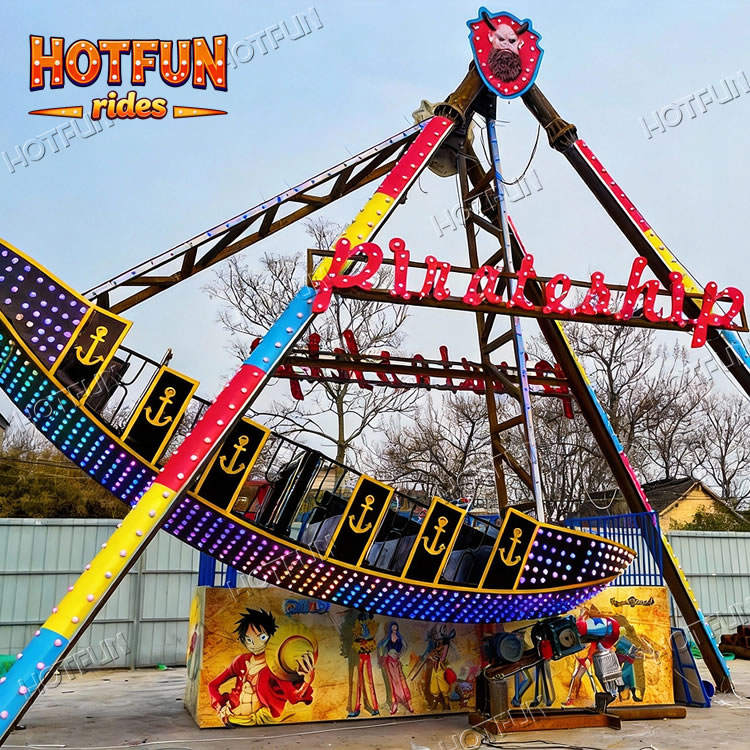
Part 2: The Engineering “Hard Injuries” Behind the Noise
1. Bearing Failure: The Silent Profit Killer
Most ‘noises’ originate from the main swing axis. While budget manufacturers often opt for standard-grade bearings to lower initial costs, these components are rarely designed for the unique radial and axial stresses of a 45-degree (or higher) swinging arc.
At HOTFUN, we’ve observed that inferior bearings lead to uneven wear patterns. Once the internal clearance exceeds 0.1mm, the resulting micro-shocks during each swing cycle act like a hammer, slowly disintegrating the bearing housing and transmitting destructive vibrations throughout the entire steel frame.
2. The Invisible Enemy: Residual Welding Stress
Why do cracks appear even on rides that haven’t reached their theoretical load limit? The answer lies in the fabrication process.
During welding, the intense heat creates internal tension within the steel. If a manufacturer skips the VSR (Vibratory Stress Relief) process, these ‘frozen’ stresses remain trapped in the structure. After roughly three years of constant oscillation, the combination of operational loads and residual stress exceeds the material’s fatigue strength. What follows is structural fatigue that no amount of superficial repainting can fix.
Part 3: The HOTFUN Engineering Fix: Why Our Frames Don’t ‘Tire’
To prevent the 3-year fatigue trap, we’ve overhauled the fabrication workflow that the industry typically takes for granted. It isn’t about using ‘premium’ materials—it’s about how those materials are treated under a torch.
Ultrasonic Testing (UT) & X-ray Weld Inspection
We don’t settle for a visual bead check. Every primary load-bearing joint on a HOTFUN Pirate Ship undergoes 100% Ultrasonic Testing (UT). This ensures zero internal slag inclusions or gas pockets—the microscopic ‘seeds’ that eventually grow into structural cracks under load reversal.
Hard-Point Machining After Welding
A common industry mistake is machining the axle housing before welding the main frame. The resulting heat distortion inevitably throws the alignment off by several millimetres. At HOTFUN, we weld the entire structure first, then use a large-scale CNC boring machine to cut the bearing seats in a single pass. This ensures the main axle sits on a perfectly co-axial line, eliminating the ‘micro-shuck’ that causes 90% of operational noise.
Q355B Manganese Steel & Shot Blasting
We specify Q355B low-alloy high-strength steel. Before the first coat of primer hits the metal, the entire frame undergoes S2.5 grade shot blasting. This doesn’t just clean the surface; it creates a compressive stress layer on the steel’s ‘skin’, which acts as a first line of defence against fatigue propagation.
Part 4: The Bottom Line: Maintenance vs. Capital Expenditure
From a pure ROI perspective, the ‘cheap’ pirate ship is the most expensive asset you will ever own. If you are forced to shut down during peak season for structural reinforcement or bearing replacement, you aren’t just losing ticket sales—you are losing the trust of your visitors.
Investing in a ride built to EN 13814 standards from the outset means your 10-year maintenance schedule looks like a simple checklist, rather than a series of emergency repairs. Engineering isn’t an invisible cost; it’s your insurance policy against the ‘3-year rattle’.