Welcome to Hotfun Rides website!

Self-Control Plane Ride Manufacturer – Interactive Air Combat Amusement Ride Solution
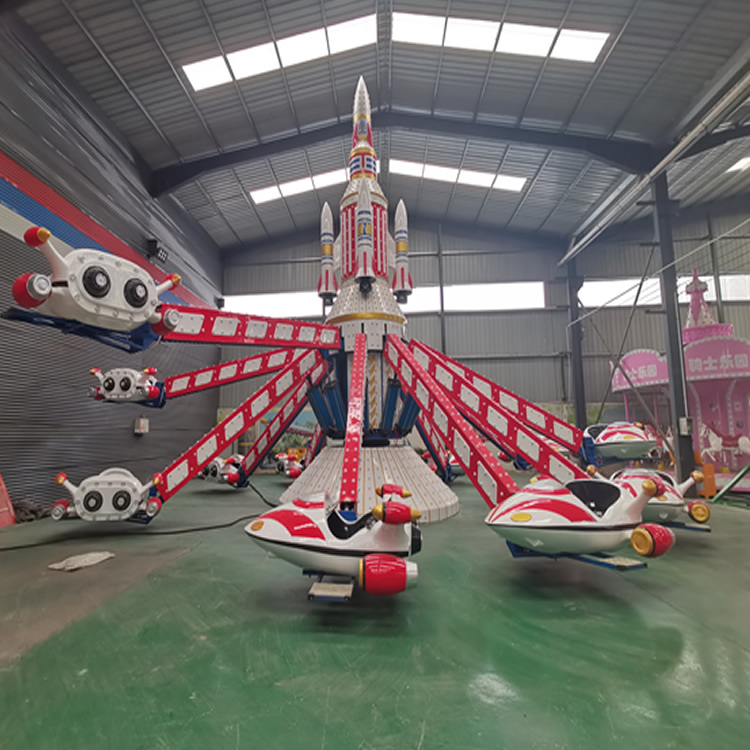
The Self-Control Plane Ride, by contrast, introduces autonomy. It rotates around a central vertical axis while allowing passengers to control their own ascent and descent. What results is not merely motion—but participation.
In traditional rotating rides, movement is predetermined. Riders sit, the machine operates, the experience ends. Engagement remains passive.
For parks seeking higher repeat rates, interactive behavior consistently outperforms static ride cycles.
What Makes a Self-Control Plane Ride Structurally Different?
Central Vertical Rotation System
At its mechanical foundation, the Self-Control Plane Ride operates through a reinforced central column connected to a calibrated slewing bearing assembly. Rotational stability depends not only on motor power, but on load distribution tolerance across each radial arm.
When properly engineered, centrifugal force remains balanced even as individual planes shift vertically at varying heights. Without such balance, vibration accumulates over time.
Precision alignment, therefore, determines durability.
Independent Up-and-Down Control Mechanism
Unlike conventional swing or carousel systems, each aircraft cabin incorporates an independent control lever. When riders pull or release the lever, a controlled lifting mechanism adjusts vertical positioning within predefined safety limits.
Key technical principles include:
- Mechanical stroke limitation to prevent excessive elevation
- Speed modulation to maintain rotational equilibrium
- Redundant locking logic to avoid sudden drops
- Anti-overload calibration in case of misuse
The result is a ride that feels free—yet operates within strict engineering boundaries.
Optional Interactive Shooting System
To intensify engagement, many operators integrate infrared or photoelectric targeting systems. Riders “pursue” neighboring planes and accumulate points via onboard sensors.
When combined with synchronized sound and lighting effects, the ride simulates an air combat environment without mechanical complexity.
Game mechanics extend dwell time. Extended dwell time improves revenue density.
Commercial Value of the Self-Control Plane Ride
Throughput and Capacity Modeling
HOTFUN configurations typically offer 8, 10, or 12 arms. Depending on seating configuration, theoretical hourly throughput ranges between 160 and 360 riders under optimized dispatch cycles.
Average cycle duration: 3–4 minutes.
Because riders control motion themselves, perceived experience length increases without extending mechanical runtime.
Operational efficiency improves without energy waste.
Repeat Ride Probability
Interactive systems generate higher re-ride behavior compared to passive rotating rides. Competitive scoring, vertical maneuvering, and visual pursuit mechanics encourage multiple tickets within the same visit.
In medium-traffic amusement venues, the Self-Control Plane Ride often achieves capital recovery within 10–20 months, depending on ticket pricing and seasonal flow.
Profitability is driven not by intensity—but by engagement.
Safety Engineering and Control Stability
Autonomy must never compromise structural integrity.
The HOTFUN Self-Control Plane Ride incorporates:
- Dual braking systems
- Emergency stop redundancy
- Phase-loss and overcurrent protection
- Height limit sensors
- Mechanical anti-fall safeguards
Directional control sensitivity is calibrated to prevent abrupt vertical shifts that could destabilize rotation balance.
Freedom exists—but within engineered constraints.
Visual Design and Thematic Atmosphere
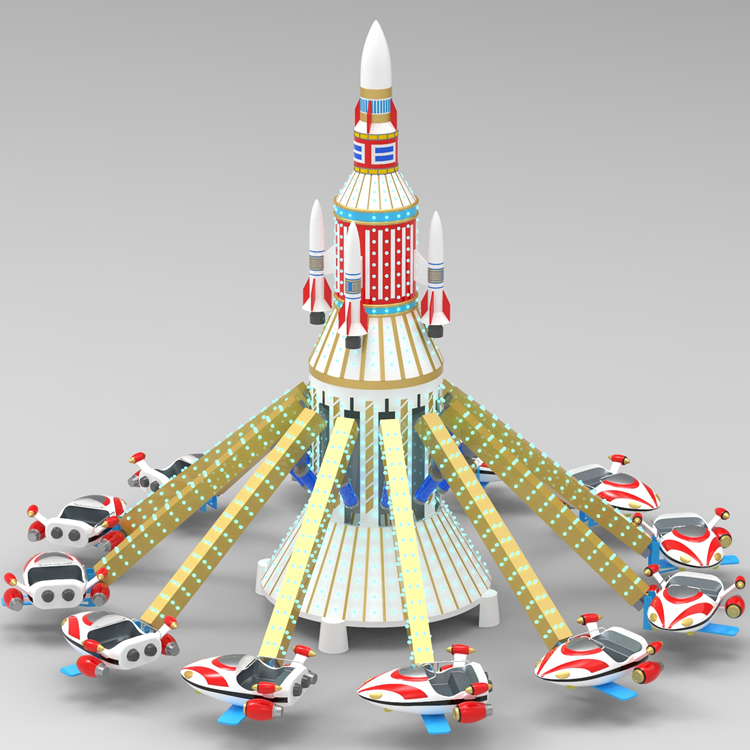
At the ride’s center typically stands a rocket-shaped or themed decorative column. Surrounding aircraft cabins are equipped with LED lighting arrays, synchronized to rotational speed and optional shooting feedback.
At night, the structure becomes a luminous centerpiece.
For parks targeting family and youth audiences, such visual identity enhances photographic appeal and social sharing exposure.
Visibility generates attraction. Attraction generates traffic.
Configuration Options and Site Requirements
Available structural variations include:
- 8-arm model (compact footprint)
- 10-arm model (balanced capacity)
- 12-arm model (high throughput configuration)
Typical footprint requirements vary based on radius and safety clearance, generally ranging between 10–16 meters in diameter depending on configuration.
Voltage customization supports international standards (380V/50Hz, 220V variants, and region-specific adjustments).
Export packaging is optimized for containerized shipment to reduce freight inefficiency.
Self-Control Plane Ride Price Range and Cost Structure
International market prices typically range from several thousand to tens of thousands of US dollars.
Price variation depends on:
- Arm quantity and structural scale
- Interactive shooting system integration
- Electrical component brand selection
- LED lighting complexity
- Anti-corrosion treatment grade
- Export certification requirements
Lifecycle cost should be evaluated alongside initial investment. Higher-grade bearings and certified electrical assemblies often reduce maintenance interruptions over long-term operation.
Short-term savings can generate long-term instability.
About HOTFUN – Certified Manufacturer of Self-Control Plane Ride
HOTFUN is a direct amusement ride manufacturer with integrated structural fabrication, electrical assembly, and international compliance management.
Certifications include:
- ISO9001 Quality Management
- CE Conformity
- TUV inspection support
- COC certification
- SABER documentation for Middle East markets
Production capabilities include:
- CNC steel processing
- Independent control cabinet assembly
- Pre-shipment dynamic load testing
- Third-party inspection coordination
- Foundation drawings and installation manuals
With export experience across Southeast Asia, the Middle East, Latin America, and selected European markets, HOTFUN designs each Self-Control Plane Ride according to region-specific voltage standards, wind load expectations, and regulatory requirements.
Transparency in documentation reduces buyer risk and accelerates approval processes.
Maintenance and Operational Management Strategy
Even with precision manufacturing, long-term stability depends on structured maintenance.
Daily inspection should include:
- Lever responsiveness check
- Cabin lifting synchronization observation
- Bolt torque confirmation
- Electrical cabinet ventilation monitoring
Weekly routines:
- Lubrication of lifting transmission components
- Brake response testing
- Safety sensor validation
Quarterly maintenance:
- Slewing bearing tolerance inspection
- Structural weld visual assessment
- LED wiring stability check
- Shooting system recalibration (if installed)
Spare parts strategy is essential. Maintaining critical components such as control modules, limit switches, and lifting transmission parts on-site reduces downtime exposure.
Equipment durability is not defined by steel thickness alone. It is determined by management discipline.
Strategic Role in an Amusement Park Portfolio
In ride portfolios dominated by high-thrill attractions, demographic gaps often emerge. The Self-Control Plane Ride bridges that gap.
Because it supports competitive interaction.
Because it encourages parent-child participation.
Because it delivers visual spectacle without fear intensity.
It functions not merely as a rotating ride—but as an engagement platform.