Welcome to Hotfun Rides website!

Teacup Ride Capacity Specs: Why the Numbers on Paper Rarely Match Real Operation
When we discuss Teacup Ride Capacity Specs with clients, the conversation usually starts very simply:
“24 seats or 36 seats—which one is better?”
At that moment, most people are still looking at the number itself.
But once a project actually moves forward—especially after installation—that question almost always changes into something else:
“Why does it feel like we’re not reaching the expected throughput?”
This is where the difference between specification and real operation starts to show.
The First Misjudgment: Treating Capacity as a Fixed Output
On paper, the calculation looks clean:
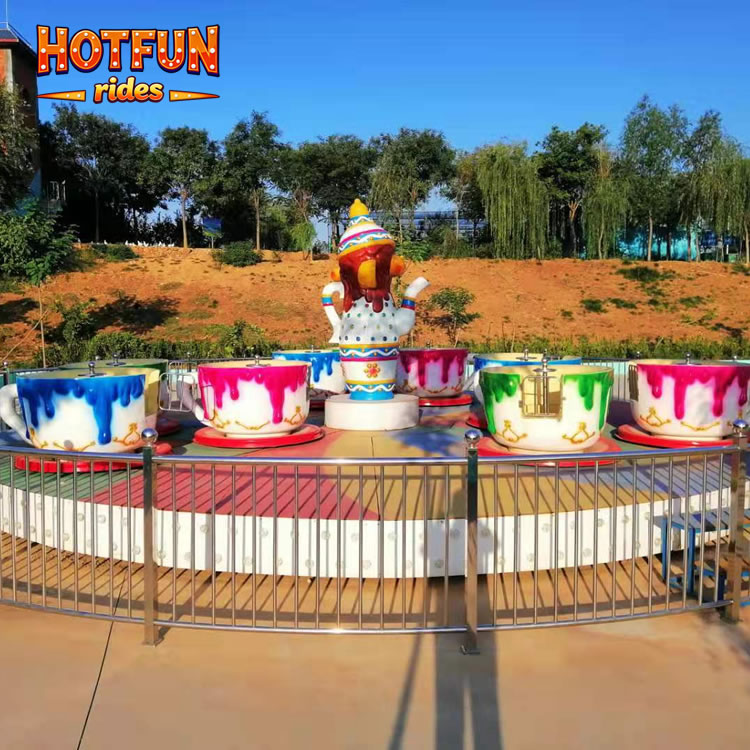
- 6 cups × 4 riders
- 8 cups × 4 riders
- 12 cups × 4 riders
That’s how Teacup Ride Capacity Specs are usually presented.
But in real operation, that “×4” is rarely stable.
We’ve seen situations where a 4-seat cup carries only 2 children because parents prefer space, or a family takes one cup but doesn’t fill it. No one forces them to optimize seat usage.
So very early in the process, we stop looking at full capacity and start thinking in terms of usable seats. In most projects, that number quietly drops to something like 70–80% of the theoretical maximum.
It’s not a technical problem—it’s just how people behave.
Where Capacity Starts to Slip: Loading Time
Another thing that doesn’t show up in spec sheets is how long it actually takes to get people on and off.
In theory, loading is quick. In reality:
- Kids hesitate before sitting
- Parents adjust positions
- Staff repeat safety instructions
These are small things, but they add up.
A cycle that was supposed to take 4 minutes becomes 5 or even 6 minutes without anyone noticing. Over an hour, that difference is significant.
So even if the Teacup Ride Capacity Specs look strong, the actual hourly output depends on how smoothly each cycle moves—not just how many seats exist.
Bigger Capacity, Slower Rhythm — This Happens More Often Than Expected
There’s a point where adding more cups starts to work against you.
We’ve had a project where the client insisted on a larger configuration. The idea was simple: more seats, more revenue.
But after installation, the issue became obvious:
- More passengers to organize
- Longer boarding time
- Slight confusion at entry and exit
The ride looked impressive, but the rhythm slowed down.
Interestingly, in another project with a smaller setup, the operator managed faster cycles with fewer delays—and the hourly throughput ended up very close.
That’s when it becomes clear that Teacup Ride Capacity Specs don’t scale linearly with performance.
Space Changes the Equation More Than People Expect
Capacity decisions don’t happen in isolation—they interact with the site.
For indoor locations especially, once the platform diameter goes beyond a certain size, everything around it gets tighter:
- Walking paths become narrower
- Queue lines start overlapping
- Operators lose clear visibility
In one mall installation, we actually reduced the planned capacity slightly—not because of budget, but because the surrounding space couldn’t support smooth flow.
After adjustment, the ride ran more efficiently, even with fewer seats.
How We Usually Approach It at HOTFUN
At HOTFUN, when we evaluate Teacup Ride Capacity Specs, we don’t start by recommending the largest model.
Instead, the process usually goes like this:
First, we try to understand the daily rhythm of the site:
- Is traffic constant or concentrated in peaks?
- Is the audience mainly children or mixed groups?
Then we look at space behavior, not just dimensions:
- Where will people queue?
- How will they enter and exit?
Only after that do we finalize the number of cups.
Sometimes the final recommendation is smaller than what the client initially expected. But in most cases, that version performs better once the ride is actually running.
One Detail That Often Gets Ignored
Something small, but it shows up often.
If the entrance and exit are not clearly separated, even a well-designed ride will lose efficiency. People hesitate, cross paths, slow each other down.
We’ve seen operators try to fix “capacity problems” that were actually just layout issues.
After adjusting the flow, the same Teacup Ride Capacity Specs suddenly delivered better results—without changing the machine at all.
Final Thought From Real Projects
After working on enough installations, one pattern becomes hard to ignore:
The best-performing teacup rides are not the ones with the highest numbers—they are the ones that feel easy to operate.
When the flow is natural, the cycles are consistent, and the staff doesn’t have to “push” the process, the ride reaches its real capacity almost automatically.
That’s when Teacup Ride Capacity Specs stop being just a number—and start reflecting how the ride actually works in daily use.