Welcome to Hotfun Rides website!
Track Vs Trackless Trains: Amusement Ride Investment & Infrastructure Comparison Guide
In the amusement industry, track train rides and trackless train rides may look similar to visitors, but from an operator’s perspective they represent two fundamentally different asset categories.
A track train ride is a rail-mounted attraction. It relies on fixed steel tracks installed as part of the park’s permanent infrastructure. Once constructed, the route becomes a long-term landscape feature and often functions as a signature sightseeing attraction within the park.
A trackless train ride, on the other hand, is a road-going electric amusement vehicle. Instead of rails, it operates on existing paved surfaces using rubber tires and electric drive systems. This makes it a flexible, deployable attraction that can be installed quickly without major construction work.
For investors and park planners, the real decision is not about appearance—it is about permanence vs. operational flexibility.
Large destination theme parks often prefer track trains because the fixed route enhances ceremony and storytelling. In contrast, shopping malls, resorts, zoos, and temporary event venues typically favor trackless trains because they require minimal infrastructure and can be relocated easily.
Understanding this structural difference is the first step in choosing the right train system for your project.
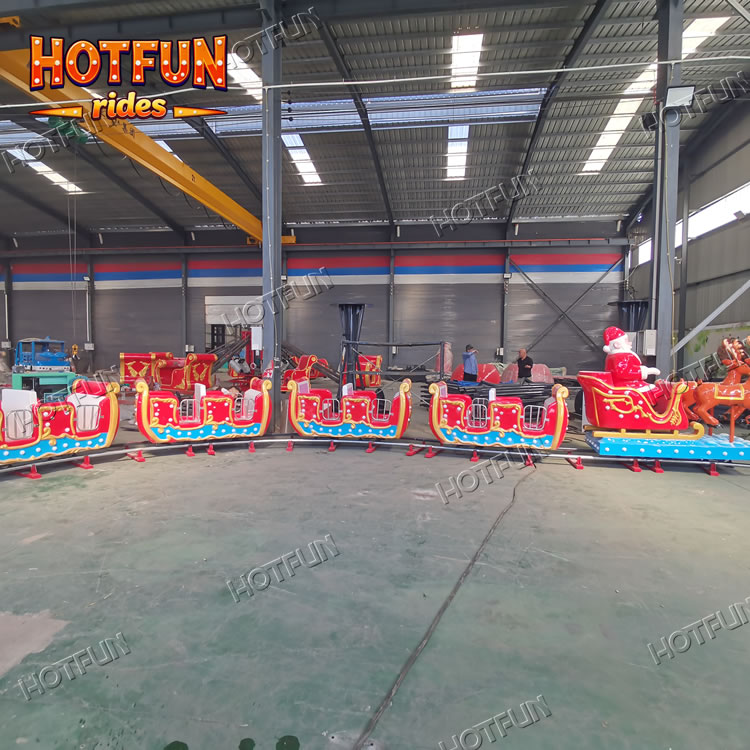
Infrastructure & Engineering Costs – Rail Installation vs Existing Roads
Track Train Rides – A Heavy Infrastructure Project
Installing a track train ride is comparable to building a miniature railway system. The process involves several civil engineering stages.
Rail foundation system
Steel rails must be supported by sleepers (railroad ties) and mounted on a prepared base layer. The rail weight specification—commonly measured in pounds per yard—determines the load capacity and durability of the system.
Drainage and ballast
Proper ballast or foundation materials are necessary to stabilize the rails and prevent water accumulation. Poor drainage can cause rail movement and long-term maintenance problems.
Civil construction costs
The installation typically includes:
- Ground trenching or surface cutting
- Leveling and foundation preparation
- Rail alignment and fastening
- Safety barriers or decorative landscaping
For permanent theme parks, these costs are justified because the railway becomes an integral part of the park’s master plan.
Trackless Train Rides – Plug-and-Play Deployment
A trackless train ride eliminates most of the infrastructure complexity.
Road compatibility
These trains can operate on a variety of hardened surfaces, including:
- Concrete walkways
- Asphalt roads
- Stone tiles or plaza paving
As long as the ground has sufficient load capacity and is relatively level, no special structural work is required.
Zero-construction advantage
Because no tracks are needed:
- Existing visitor routes remain unchanged
- Installation can be completed within days
- No physical barriers or rail alignment are required
For commercial venues such as shopping centers or tourist streets, this low entry threshold makes trackless trains extremely attractive.
Power Systems & Turning Geometry
Steering Logic Comparison
The way these trains turn is fundamentally different.
Physical rail guidance
A track train ride relies on steel wheel flanges engaging with the rail. The rail itself determines the path, allowing extremely tight turning radii while maintaining stability. However, the route cannot be changed without rebuilding the tracks.
True-Track steering technology
HOTFUN trackless train rides use mechanical linkage steering systems, sometimes called True-Track Steering.
In this system:
- Each carriage axle is mechanically synchronized
- The trailers precisely follow the locomotive’s path
- The design eliminates “off-tracking,” where trailers cut inside corners
This allows multi-car trains to move smoothly through narrow pedestrian areas without collision risks.
Climbing Ability & Traction
Another key difference is traction performance.
Steel wheel on steel rail
Rail systems have extremely low rolling resistance, which improves energy efficiency. However, the friction coefficient is relatively low, limiting climbing capability on steep slopes.
Rubber tire traction
Trackless trains use rubber tires, which provide stronger grip on paved surfaces. This allows them to handle gradients above 5% more effectively, making them better suited for parks with uneven terrain.
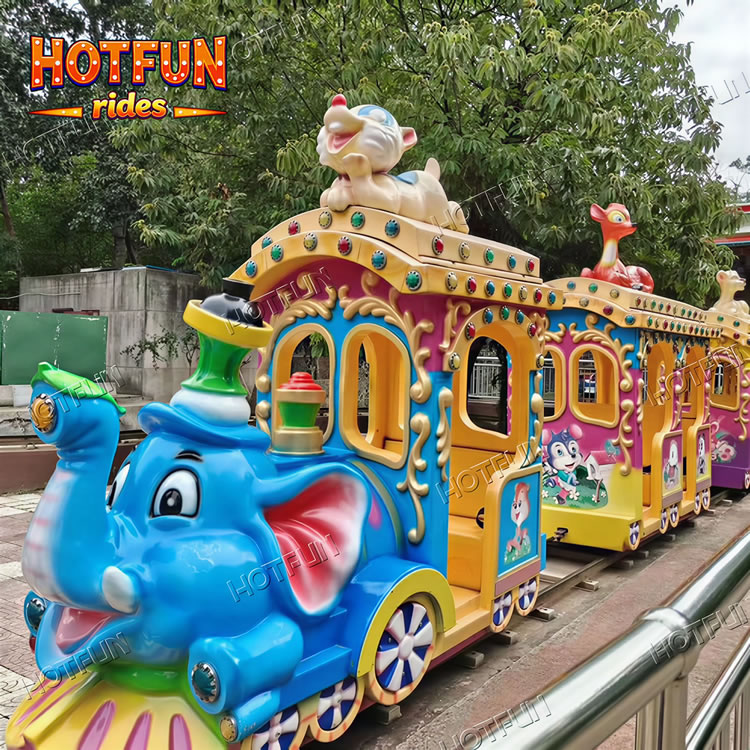
Operational Safety & Compliance Standards
Passive Safety – Rail System
Track trains benefit from path exclusivity. Since the train only travels on rails, pedestrians and other vehicles cannot easily enter its path. This naturally reduces collision risks.
Active Safety – Trackless System
Trackless trains rely more on active safety technology, such as:
- Ultrasonic obstacle detection sensors
- Electronic speed limiting systems
- Emergency braking systems
These features allow the train to operate safely within mixed pedestrian environments.
Maintenance Cycles
Maintenance requirements also differ.
Track trains typically require:
- Rail lubrication
- Periodic rail alignment checks
- Structural inspection for metal fatigue
Trackless trains focus more on vehicle components:
- Tire wear monitoring
- Electric motor maintenance
- Brake system inspections
Both systems can achieve long operational lifespans when maintained properly.
Asset Strategy & ROI Considerations
When choosing between train systems, operators often evaluate long-term financial performance.
Depreciation & Asset Liquidity
A trackless train ride is classified as mobile equipment. Because it does not depend on fixed infrastructure, it can be:
- Resold more easily
- Transferred between parks
- Used for seasonal events
This mobility gives the asset stronger liquidity.
Visitor Experience Value
A track train ride often becomes a visual landmark within a park.
The railway route can pass through themed landscapes, lakes, or gardens, turning transportation into a storytelling attraction. In large theme parks, this experiential value can significantly enhance guest immersion.
Energy Efficiency
Both systems are commonly powered by electric drive systems.
Track trains benefit from low rolling resistance, reducing energy consumption over long routes.
Trackless trains consume slightly more energy due to tire friction but compensate with flexible routing and shorter operating circuits.
Engineering FAQ – Real Procurement Questions
What is the difference between solid tires and pneumatic tires on trackless trains?
Trackless train rides generally use either solid rubber tires or pneumatic (air-filled) tires.
Solid tires are extremely durable and puncture-resistant, making them suitable for high-traffic commercial environments such as amusement parks, plazas, or zoos. They require minimal maintenance but transmit more vibration on uneven surfaces.
Pneumatic tires offer better shock absorption and smoother rides, especially on decorative stone paving or slightly uneven ground. However, they require periodic pressure checks and are more vulnerable to punctures.
For most amusement train applications, solid tires are the preferred choice due to their long service life and operational reliability.
Can trackless trains run on grass surfaces?
Technically, they can move on compacted grass for short distances, but grass alone is not recommended as a primary operating surface.
Soft ground creates higher rolling resistance and can lead to tire sinking, especially when the train is fully loaded. Over time, repeated operation can damage the lawn and reduce traction during wet conditions.
Most operators install at least a reinforced paved path such as concrete, asphalt, or interlocking stone tiles to ensure smooth operation.
How do you choose the rail gauge for track train rides?
Rail gauge—the distance between rails—is a critical parameter for track train ride design.
Two common gauges used in amusement parks are:
15-inch gauge
- Suitable for small scenic trains
- Lower construction cost
- Best for children’s rides or short routes
24-inch gauge
- Higher structural strength
- Supports larger locomotives and passenger capacity
- Preferred for large scenic railways
The choice depends on passenger load, route length, and visual scale requirements.
How is heat managed in electric drive systems with frequent stops?
Amusement trains often operate in stop-and-go cycles, especially in crowded parks.
HOTFUN electric drive systems manage heat through:
- High-efficiency brushless motors
- Integrated cooling fans
- Thermal protection controllers
These systems monitor motor temperature in real time. If the system approaches thermal limits, the controller can temporarily reduce output power to prevent overheating.
Proper system design ensures reliable performance even during continuous daily operation.
How can indoor venues reduce electric motor noise?
Indoor environments such as shopping malls require stricter noise control.
Manufacturers typically use several methods to minimize motor noise:
- Rubber isolation mounts to reduce vibration
- High-precision gearboxes to eliminate mechanical whining
- Acoustic insulation inside the locomotive housing
These measures ensure that the train operates quietly without disturbing the surrounding retail environment.
Conclusion – Building Your 5-Year Investment Model
Choosing between track train rides and trackless train rides ultimately depends on your project strategy.
If your park requires a permanent scenic landmark with strong thematic value, a track railway system may be the better choice.
If you prioritize flexible routes, low infrastructure cost, and faster return on investment, a trackless train system will likely provide greater operational efficiency.
For investors planning new attractions, the best approach is to evaluate the project through a five-year operational model, including construction cost, maintenance requirements, passenger capacity, and expected visitor flow.
If you already have a site plan, providing satellite images or CAD layout drawings allows professional manufacturers to simulate routes, calculate energy consumption, and design optimized train paths before installation.