Welcome to Hotfun Rides website!






Ferris Wheel Ride Passenger Capacity: How Many Riders Can a Ferris Wheel Carry?
Why Ferris Wheel Ride Passenger Capacity Matters for Park Planning
When park investors evaluate large attractions, one of the first questions they ask is about Ferris Wheel Ride Passenger Capacity. Unlike thrill rides that focus mainly on excitement, a Ferris wheel is also expected to handle a steady flow of visitors throughout the day.
In real park operations, Ferris Wheel Ride Passenger Capacity directly affects queue time, visitor satisfaction, and revenue efficiency. If the capacity is too low, long waiting lines can appear during peak hours. On the other hand, a well-planned Ferris wheel system can move hundreds of passengers every hour while maintaining a smooth and relaxing ride experience.
Many operators notice that Ferris wheels are especially popular with families, tourists, and couples. Because the ride cycle is relatively gentle and scenic, cabins are often filled quickly during weekends and holidays. For this reason, understanding Ferris Wheel Ride Passenger Capacity is an important part of amusement park layout and attraction planning.
How Ferris Wheel Ride Passenger Capacity Is Calculated
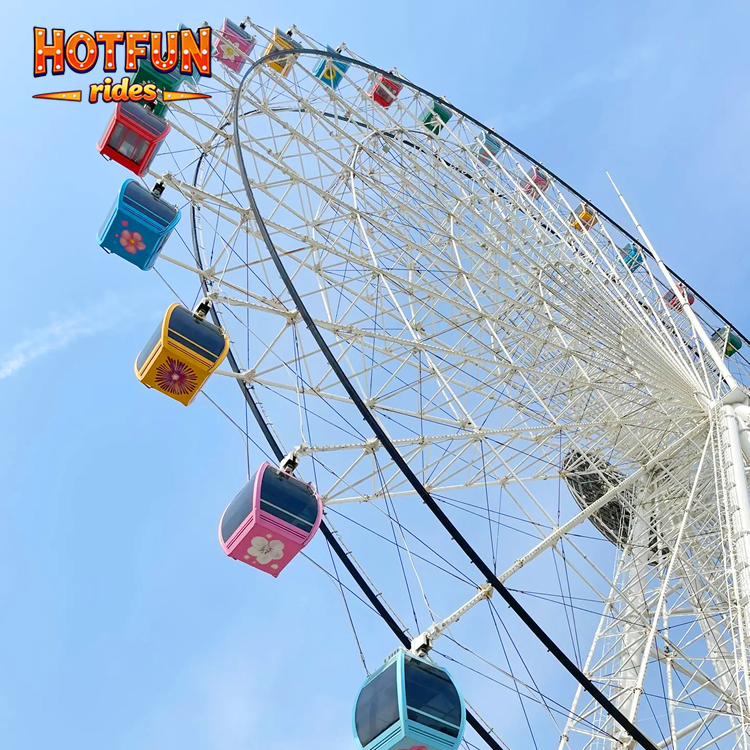
From an engineering perspective, Ferris Wheel Ride Passenger Capacity is determined by several key factors. These include the number of cabins, passengers per cabin, and the total ride cycle time.
A simplified formula often used by park planners is:
Passenger Capacity per Hour = Cabins × Passengers per Cabin × Cycles per Hour
For example, if a Ferris wheel has:
- 24 cabins
- 6 passengers per cabin
- 4 full rotations per hour
The approximate Ferris Wheel Ride Passenger Capacity would be:
24 × 6 × 4 = 576 passengers per hour
Of course, the real capacity may vary slightly depending on boarding speed and operational efficiency. However, this formula provides a reliable estimate for park planning.
Typical Ferris Wheel Ride Passenger Capacity by Wheel Size
In practice, the capacity of a Ferris wheel increases as the wheel diameter and number of cabins increase. Smaller observation wheels may focus on scenic viewing rather than high throughput, while large park wheels are designed to handle greater visitor volumes.
Below are typical examples seen in amusement parks.
Small Ferris Wheels
Small wheels are often installed in family parks, plazas, or indoor entertainment centers.
Typical specifications:
- Diameter: 10–16 meters
- Cabins: 12–16
- Passengers per cabin: 4–6
Estimated Ferris Wheel Ride Passenger Capacity:
These wheels work well for smaller parks where visitor flow is moderate.
Medium Amusement Park Ferris Wheels
Many theme parks choose medium-sized Ferris wheels because they balance capacity, visibility, and investment cost.
Typical specifications:
- Diameter: 20–35 meters
- Cabins: 18–24
- Passengers per cabin: 6–8
Estimated Ferris Wheel Ride Passenger Capacity:
400 – 700 passengers per hour
In many installations, this level of Ferris Wheel Ride Passenger Capacity is sufficient to handle family crowds without creating long queues.
Large Observation Wheels
Large observation wheels installed in major tourist destinations are designed to carry significantly more passengers.
Typical specifications:
- Diameter: 40–60 meters or more
- Cabins: 24–36
- Passengers per cabin: 6–10
Estimated Ferris Wheel Ride Passenger Capacity:
800 – 1200 passengers per hour
These installations often become iconic landmarks and serve both entertainment and sightseeing purposes.
Engineering Factors That Influence Ferris Wheel Ride Passenger Capacity
Although the number of cabins is important, several engineering elements also affect the real Ferris Wheel Ride Passenger Capacity.
Boarding Efficiency
In many parks, loading and unloading passengers takes place while the wheel rotates slowly. This continuous loading system allows the attraction to maintain a stable operating rhythm.
A well-organized boarding process can significantly increase effective Ferris Wheel Ride Passenger Capacity.
Cabin Layout and Passenger Comfort
The seating layout inside each cabin also affects capacity. If cabins are too small or uncomfortable, operators may reduce the number of riders per cabin to maintain safety and comfort.
From a design perspective, Ferris Wheel Ride Passenger Capacity must always be balanced with passenger space and safety requirements.
Ride Cycle Duration
A longer rotation cycle can improve the sightseeing experience but may reduce the number of cycles per hour. Many parks therefore choose a cycle time between 10 and 15 minutes, which maintains both visitor satisfaction and reasonable Ferris Wheel Ride Passenger Capacity.
Manufacturing Considerations Behind Reliable Capacity
From a structural engineering standpoint, maintaining stable Ferris Wheel Ride Passenger Capacity requires precise mechanical design.
Manufacturers such as HOTFUN design Ferris wheel systems using reinforced steel structures and balanced cabin distribution. This helps ensure smooth rotation even when passenger loads vary between cabins.
During the manufacturing process, engineers at HOTFUN carefully test the wheel balance, cabin suspension system, and drive mechanism. These procedures help guarantee that the wheel can safely handle its designed passenger load while maintaining stable motion.
This type of engineering attention is particularly important for larger wheels where the total passenger weight can reach several tons during operation.
How Operators Optimize Ferris Wheel Ride Passenger Capacity
In daily park operations, several strategies are commonly used to improve Ferris Wheel Ride Passenger Capacity.
First, operators train staff to guide passengers efficiently during boarding. Clear instructions and organized queues reduce loading delays.
Second, regular maintenance ensures the wheel rotates smoothly without unnecessary stops.
Finally, many parks schedule Ferris wheel operations to match visitor traffic patterns. For example, the ride may run continuously during peak hours but operate at slower intervals during quiet periods.
These small operational adjustments help maintain consistent Ferris Wheel Ride Passenger Capacity throughout the day.
Conclusion
Understanding Ferris Wheel Ride Passenger Capacity is essential for amusement park planning and attraction management. The number of cabins, passenger seating, and ride cycle time all play important roles in determining how many riders a Ferris wheel can serve each hour.
When designed with strong engineering standards and balanced structural systems—such as those used by HOTFUN—Ferris wheels can provide reliable passenger capacity while delivering a relaxing and memorable experience for visitors.
For park investors and operators, choosing the right Ferris wheel size and capacity ensures both operational efficiency and long-term attraction value.