Welcome to Hotfun Rides website!






Pirate Ship Ride for Sale: Full Size and Price Guide
Most buyers looking for a Pirate Ship Ride for Sale begin with simple questions—price, size, certifications, and basic specifications.
However, once you are truly involved in a project, one thing becomes clear very quickly:
The main reason projects fail to generate profit is not due to the equipment itself, but because the wrong model was selected—too large, too small, or simply not suitable for the site and expected visitor flow.
This guide does more than answer common questions. It helps you understand how to choose the right model for your specific project.
Why Pirate Ship Ride Remains a Core Attraction in Modern Parks
The Pirate Ship Ride continues to be popular for one simple reason: practicality.
It does not require excessive initial investment, and it offers a wide range of configurations—from small to large, including portable versions—covering almost every type of venue and audience.
A Pirate Ship Ride for Sale naturally occupies a strong position because it offers:
- Flexible space requirements
- Broad audience appeal
- High acceptance among most visitors
This balance allows it to operate continuously throughout the day, not just during peak hours, resulting in a relatively fast payback period.
For this reason, the pirate ship remains a long-standing, reliable attraction in amusement parks.
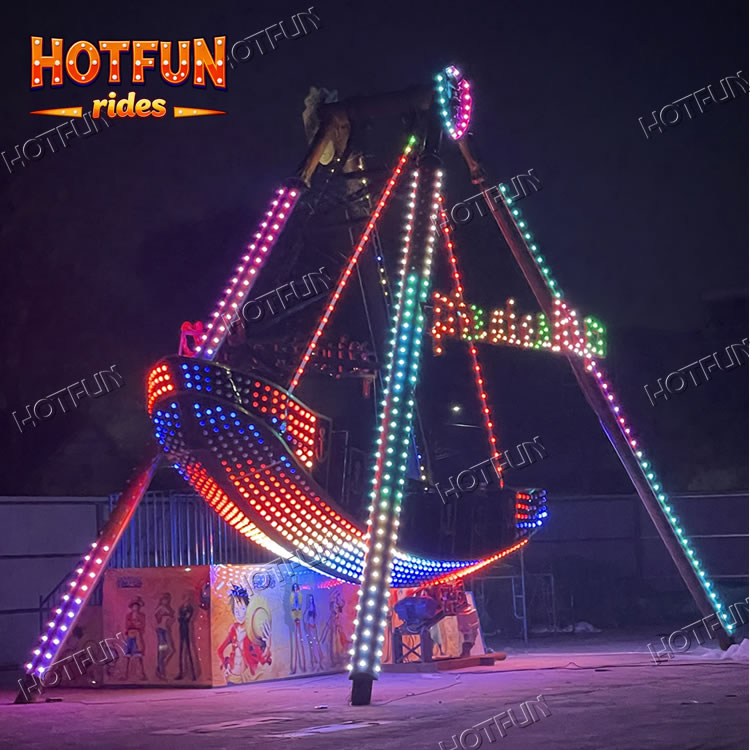
Pirate Ship Ride Types: What Really Matters for Your Project
In real projects, we do not classify a Pirate Ship Ride for Sale simply by name, but by its practical application.
For example:
- 12-seat models → typically used in small parks or for initial investment testing
- 24–36 seat models → the most common configuration, suitable for long-term operation
- 42 seats and above → usually for large theme parks with sufficient visitor traffic
- Portable pirate ship rides → a completely different category, equipped with wheels, allowing relocation without a fixed site; often foldable and ideal for mobile operators
A common mistake among buyers is choosing based on appearance rather than actual site conditions and expected visitor flow.
Size Selection: Bigger Is Not Always Better
Large Pirate Ship Ride for Sale models often look more attractive.
However, in many real cases:
- Larger size → longer payback period
- Higher investment → more complex maintenance
- Increased labor cost → reduced actual profit
If your park does not have sufficient visitor traffic, a small or medium-sized pirate ship will often perform better than a large one.
How a Pirate Ship Ride Operates (From an Operator’s Perspective)
Technically, a pirate ship is based on a pendulum system.
In actual operation, a Pirate Ship Ride for Sale runs in a cycle:
- Gradual lifting
- Peak swinging
- Controlled deceleration
What truly matters is not the motion itself, but whether the ride can operate continuously and efficiently throughout the day.
Why Stopping Performance Matters More Than Motion
Many buyers focus on how the ride moves, but experienced operators pay more attention to how it stops.
A well-designed Pirate Ship Ride for Sale should:
- Gradually reduce swing amplitude
- Avoid sudden braking
- Align smoothly for unloading
If the stopping process is unstable, daily operation efficiency will quickly decline.
What Really Determines the Price
Price is one of the most common questions—but often asked in the wrong way.
The cost of a Pirate Ship Ride for Sale is not limited to the equipment itself. It is influenced by:
- Seating capacity
- Structural weight
- Decorative complexity
- Transportation volume
- Installation difficulty
In many projects, logistics and foundation costs surprise buyers more than the equipment price itself.
Is a Pirate Ship Ride Safe? A Practical Perspective
Based on industry experience, a Pirate Ship Ride for Sale is considered a relatively stable type of amusement ride.
Not because it is simple, but because:
- Its motion is predictable
- Stress points are well understood
- The design is mature across the industry
Problems usually arise not from design, but from:
- Poor installation
- Skipped inspections
- Excessive use without proper maintenance
What Are the Chances of Mechanical Failure
Failures are rarely random.
When a Pirate Ship Ride for Sale experiences issues, it is usually due to:
- Neglected wear components
- Misalignment during installation
- Lack of routine inspection
In well-managed parks, downtime is minimal and predictable.
How Much Space Do You Really Need
This is another area where buyers often miscalculate.
It is not just about the ride size—you also need to consider:
- Swing clearance
- Safety buffer zones
- Waiting and queue areas
Even if a Pirate Ship Ride for Sale technically fits the space, poor surrounding layout can reduce its operational efficiency.
How Does a Pirate Ship Ride Generate Revenue
Expectations should be realistic.
A Pirate Ship Ride for Sale is not typically the highest-priced attraction.
However, it generates consistent income because:
- It operates throughout the day
- It serves a wide audience
- It rarely remains idle
In many parks, it is not the main highlight, but one of the most reliable revenue sources.
Choosing a Manufacturer: What Experienced Buyers Look For
Price is easy to compare—reliability is not.
When evaluating a Pirate Ship Ride for Sale, experienced buyers focus on:
- Whether the supplier has real project experience
- Whether technical specifications are clear
- Whether communication is practical rather than purely sales-driven
A good manufacturer will not simply recommend the largest model—they will first evaluate your project needs.
Import and Delivery: Where Delays Usually Occur
Importing a Pirate Ship Ride for Sale is not complicated, but delays often occur due to:
- Unclear specifications in early stages
- Shipping coordination issues
- Construction site not being ready upon arrival
Most delays are caused by planning issues, not production problems.
Installation and Maintenance: Where Projects Succeed or Fail
Installation is where theory meets reality.
A Pirate Ship Ride for Sale performs well only when:
- The foundation is accurate
- The structure is properly aligned
- Testing is completed correctly
Maintenance itself is not complicated, but it must be consistent. Skipping small checks can lead to larger issues later.