Bienvenue sur le site Web de Hotfun Rides !

Carousel Ride Size: Real Space Guide by Model
Introduction
If you have ever tried to install a carousel on-site, you probably already know this:
What looks “small” on a drawing rarely feels small once it arrives.
The biggest issue we see in real projects is not price, not shipping, not even installation—it’s space misjudgment.
Clients think they are buying a 6-meter ride, but what they actually need is closer to 8 or even 9 meters when everything is considered.
That gap is where delays happen.
So instead of giving you a generic parameter list, this guide focuses on one thing only:
what a Carousel Ride Size really means when you put it on the ground.
All data below is based on actual delivery experience from HOTFUN, across indoor parks, outdoor plazas, and tourist sites—not just catalog specs.
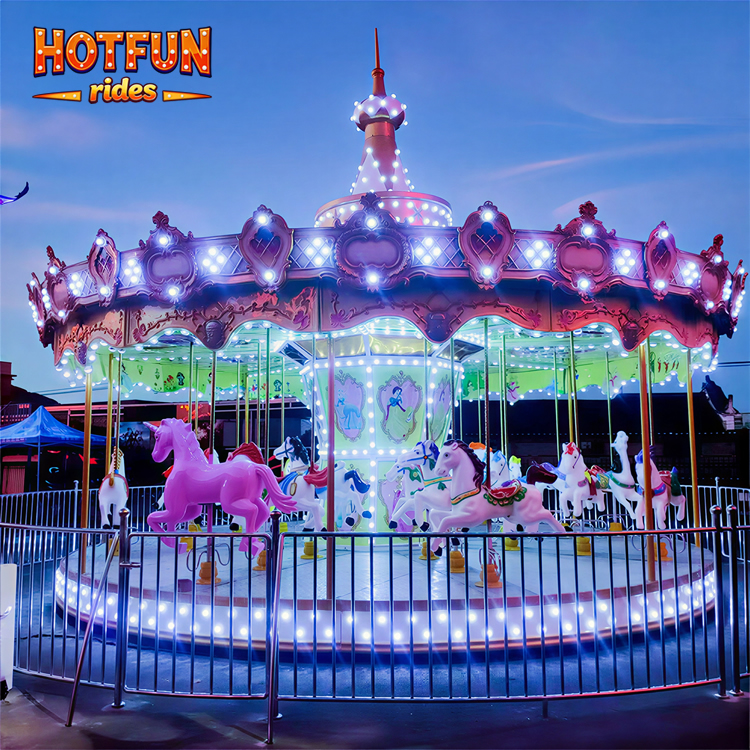
First Clarification: Carousel Ride Size Is Not Just Diameter
This is where most first-time buyers go wrong.
When a supplier says “7-meter carousel”, they are talking about the main rotating structure only.
But when you install it, the ride doesn’t exist in isolation.
You still need space for:
- People getting on and off
- Operators moving around
- Safety clearance (this one is often mandatory, not optional)
- Fences, especially for outdoor parks
In practice, I usually tell clients:
If you only measure the ride itself, you’re already underestimating.
6-Seat Carousel Ride Size — Looks Easy, Still Gets Misjudged
This is the smallest model, and ironically, the one most often miscalculated.
- Ride diameter: about 3.5–4 m
- Realistic space: around 5 × 5 m
At first glance, that seems straightforward. But on-site, two issues appear:
- Operators don’t have enough room to move
- If you add even a simple fence, the layout becomes tight very quickly
This model works well indoors, but only if the surrounding space is already planned—not improvised later.
16-Seat Carousel Ride Size — Where Space Starts to “Feel Different”
- Ride diameter: about 5–5.5 m
- Recommended area: 7 × 7 m
This is usually the first “park-level” model.
What changes here is not just size—it’s people behavior.
Once you reach 16 seats:
- Parents start gathering around
- Kids don’t exit immediately
- Small queues begin to form
If your layout doesn’t allow a natural flow, the ride area gets crowded faster than expected.
24-Seat Carousel Ride Size — The Most Balanced, but Not Always Safe by Default
- Ride diameter: about 6.5–7 m
- Recommended area: 9 × 9 m
This is probably the most commonly selected size, and for good reason—it fits many parks without feeling too large.
But here’s something we’ve seen multiple times:
Projects choose this model because it “fits on paper”,
but forget that at this scale, you need controlled entry and exit, not just open access.
Otherwise:
- Guests cluster near the platform
- Operators lose visual control
- Loading time increases
So yes, it’s balanced—but only if the layout supports it.
36-Seat Carousel Ride Size — Now You Are Managing a Zone, Not Just a Ride
- Ride diameter: about 8–9 m
- Recommended area: around 11 × 11 m
At this point, the carousel is no longer a small attraction—it becomes a traffic node inside your park.
What usually changes:
- You need defined queue lines
- Entry and exit must be separated
- Fencing becomes almost necessary
If you skip these, the problem is not safety first—it’s operational chaos.
56-Seat Carousel Ride Size — Space Becomes Strategy
- Ride diameter: about 10–12 m
- Recommended area: 13 × 13 m or more
This is where things shift completely.
Clients often ask:
“Can we reduce the surrounding space a bit?”
Technically, maybe.
Operationally, it’s a bad idea.
Because at this size:
- The ride attracts crowds even when not running
- People use it as a meeting point
- Photos, waiting, and circulation all overlap
So the space you reserve is not just for safety—it’s for how people naturally gather.
A Quick Reality Table (What Actually Works On-Site)
| Seats | Ride Diameter | Space You’ll Actually Need |
|---|---|---|
| 6 | 3.5–4 m | ~5 × 5 m |
| 16 | 5–5.5 m | ~7 × 7 m |
| 24 | 6.5–7 m | ~9 × 9 m |
| 36 | 8–9 m | ~11 × 11 m |
| 56 | 10–12 m | ≥13 × 13 m |
Not theoretical. These are the sizes that avoid problems later.
The Things Clients Usually Realize Too Late
After installation starts, a few patterns repeat across projects:
- “We didn’t leave space for the fence”
- “The queue blocks the walkway”
- “Maintenance access is too tight”
- “It passed installation, but not inspection”
None of these are equipment issues.
They are all Carousel Ride Size misunderstandings.
How Experienced Buyers Actually Decide
The decision process is usually less about “which model is better” and more about:
- What space can we realistically use—not just measure?
- How many people will gather here at peak time?
- Do we want this to be a small ride, or a visual center?
Once these are clear, the right Carousel Ride Size becomes obvious.
Why Layout Support Matters More Than You Think
A good supplier doesn’t just send dimensions.
At HOTFUN, most serious projects involve:
- Adjusting layout based on site shape (not just square space)
- Planning access paths before installation
- Considering how operators actually work on-site
Because in reality, a ride that “fits” is not enough.
It has to work every day without friction.
Conclusion
The real meaning of Carousel Ride Size only becomes clear when the equipment is placed on-site and people start interacting with it.
Every size—from 6 seats to 56 seats—follows its own logic.
Ignoring that logic usually doesn’t stop a project—but it almost always creates problems later.
Final Thought
When you choose a carousel, you’re not just choosing a ride.
You’re deciding how people move, wait, gather, and experience that space.
So the real question is not:
“Which size can fit?”
But:
“Which size will actually work here—every single day?”